Showing posts with label Elsies Peak. Show all posts

01 April 2015

Three black dogs on a burnt mountain

On Sunday we drove past the burned slopes of Kalk Bay to Fish Hoek where we met Alice and Maddie,
AND Sue and Honey. It was lovely to see them again. Honey still doesn't really like me though.
We walked towards Elsie's Peak from Ravine Steps, through the burned area from last November's fire that nearly burned Alice's house down.
It was hot and sandy, but things were beginning to grow back again.
All these leucadendrons are re-sprouting from the base.
There were lots of asparagus plants (maybe A. rubicundis) coming up in the burned areas - this one with its own crab spider.
Round the corner we could see over Glenciarn and all the way to Cape Point. Laddie doesn't appreciate the views like me though, just look at him diving into the fynbos after some imaginary rodent. What a clot.
This is Maddie's favourite look out point - so I joined her. 
And so did Honey - with a bit of persuasion from Sue and the photographing phood lady.
Then I saw the Easter Bunny popping up from behind the rocks!
Alice took us on the Path-Less-Trodden, past the False Heath (Audouinia capitata) which wasn't flowering yet,
and past some very fragrant Box Phylica (Phylica buxifolia),
and a small Sticky Heath (Erica viscaria subsp. viscaria) coming up in the middle of the path.
And growing and glowing on the edge of a rock was this Fynbos Aloe (Aloe succotrina).
A pair of Cape Rock Thrushes were hitching a ride on a rock monster.
Then it was tea-time overlooking Fish Hoek and False Bay. Laddie just couldn't sit still for a second and dived off into the bushes - leaving his tail in the photo.
He is just like Dougal and leaps and scuffles around in the fynbos all the time
just hoping to find a lizard to chase ...
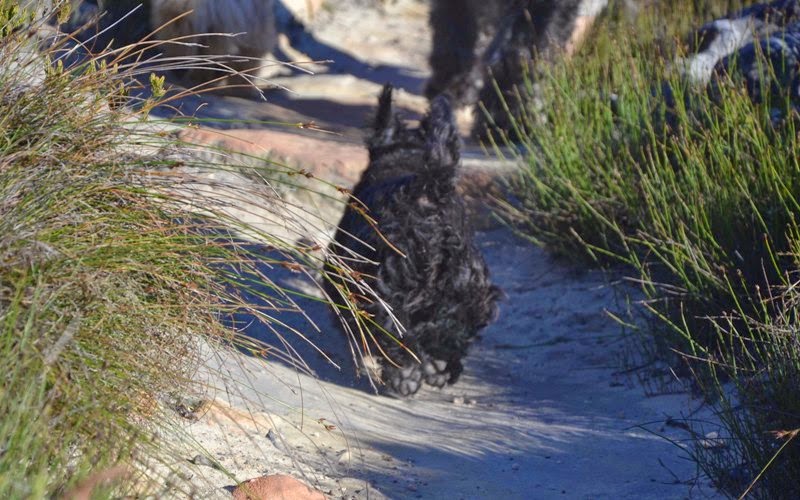
After tea we set off down another Path-less-Trodden - me kicking up my heels.
It was rather steep!
Some edge-to-edge carpeting belonging to the fire-starting, porcupine-trapping vagrants that live up here.
Back down on the road - with the Shark Spotters under the umbrellas behind us.
On the way home we passed this family begging on the island in the middle of the busy road at the Ladies Mile-Spaanschemat intersection. The Food Lady is always sorry for the kids and hopes they don't get run over by a mad, speeding car.
And when we got home we found this huge grasshopper trying to get into the car. Well, we didn't see it or it would have been a very dead grasshopper!

23 July 2013

The three black dogs climb Elsie's Peak

On Sunday, us three black dogs met at the top of Ravine Steps in Fish Hoek, and set off up the path with our humans - Sue, Alice, the Alf and the Food Lady.
Looking down on a Glistening Ink Cap (Coprinus micaceus). As it was quite warm, I wondered if there were any fairies under there, but there were none.
And, still in a whirl, a budding Gold Spiderhead (Serruria villosa).
Where were we going? Why, up Elsie's Peak of course. To look for a very rare and endangered flower that we've seen before, but like to see it when it flowers.
Wat is this? No. This is a protea hybrid between the naturally occurring Protea lepidocarpodendron and a planted Protea neriifolia. (For more about it, go to iSpot.)
Was it this then? Yay - found! The rare and endangered False Heath (Audouinia capitata) flowering jauntily, and we even found another bush further down the path too.
Looking down on Glencairn all the way back to Simons Town.
Another unusual flower - the Small Mountain Dahlia (Liparia parva) which is not a dahlia but a pea and it is pollinated by mice.
Tea below the peak. The Alf, Sue, Honey, Alice and Maddie.
Maddie checking for dassies and lizards. We share a taste for the finer things in life like tormenting dassies and lizards. (Although we haven't had much luck as yet but it doesn't stop us from trying.) Dougal was a mouse man, but we black dogs are lizard and dassie and baboon aficionados. (Actually Honey is not sure what she is yet, but give her time.)
Another whirly spiderhead - the Wynberg Spiderhead (Serruria cyanoides). It is also rare and endangered, and endemic to the Cape Peninsula and nowhere else.
Spring in the air? Some little Babiana villosula flowers opening up in the sunshine - which was becoming quite fierce!
We walked right under the cliffs which was very exciting as there were lots of dassies and black lizards skittering and shouting at us. Maddie tried hard to climb the cliff but Alice pulled her back.
After all those exertions in the hot sun, we settled down in some shade for a drink.
Then down the road past the shark spotters and the posh houses,
back to ravine steps. Sue and Honey had a lunch date, so left in Sue's zooty little white car,
and we went back to Alice and Maddie and Omie Dome's house for tea.
I did a spot of train-spotting. (This is the Atlantic Rail Sunday Steam Train.)

31 July 2012

Baboons and Brakkloofrant

Sun on Sunday for a change! And some spaniels and a bouvier were waiting for us when we arrived at the start of the Elsie's Peak walk, but the spaniels soon left - and there they go with Omie Domes (their human) past the piles of quarried stone that is left over from when Elsie's Peak was a quarry for building stone and road gravel. We think the walls and ruins at the start of the walk on Mountain Road must have something to do with the quarry works. Sue and Thea soon joined us after taking the wrong road thanks to the Food Lady's incorrect instructions! An unconcerned Cape Grassbird. They have recently changed family (which is what I would like to do too sometimes) thanks to molecular research on their genes. They used to be part of the warbler family Sylviidae (larks and swallows) but now have their own family, the African Warblers (Macrosphenidae) which only share a distant relative with the Sylviidae.
There were lots of these little plants growing in the damp sand of the path, and when you open them up ... they look like this. Men-in-a-boat (Colchicum eucomoides). We walked across to the other side of the mountain with lovely views over Glencairn and Simons Town.Then Alice and the Food Lady saw an interesting plant - the rare (on the Red List) False Heath (Audouinia capitata), which is only known from about 15 localities on the Peninsula and near Hermanus. It is member of the Brunia family (Bruniaceae) but masquerades as an erica. It is a resprouter – which means it needs fire in order to maintain a healthy population. According to Tony Rebelo, most resprouters thrive in the two to five years after a fire and then die down - so that in 10-year old veld they are often leggy and half dead. On the other hand many of these fynbos resprouters are astonishingly old - as much as 300-800 years old! Every fire prunes and revitalizes them, so although they are very old they don’t look their age (in young veld that is). For more interesting facts on fynbos resprouters and Andouinia click here. And look how patiently Maddy is sitting while all this is being explained! I, on the other hand had left long ago with the Alph, and we had discovered some ... BABOONS! But before we could get at them, the Alph clapped us in leads. Spoilsport.
So all we could do was watch - and quiver a bit. Just you keep watching out baboon! Shirley Strum is strumming up support to have you lot chased FAR away where you belong.While we fantasized about chasing baboons all the way to Cape Point, the Food Lady and the others carried on botanising. This is a Granny Bonnet/Moederkappie (Disperis capensis var. capensis) that is also sometimes called a Cape Witch Orchid.
A pretty blue Pyjamabush or Agtdaegeneesbos (Lobostemon fruticosus). A member of the Forget-me-not family, Boraginaceae.
Teatime! With shaved kudu carpaccio (we dogs only got a faint whiff of this most delicious offering from Thea), Sue hiking biscuits (ditto), same old same old rusks (a tiny crumb), and same old same old beanos (two each). Maddy, Alice, Sue, the Alph with me still on the lead because of baboon smells, and Thea. FL taking the photo, and Dougal deep in a rodent hunt somewhere.
Beautiful pink and silver Amphithalea ericifolia - a member of the fabulous Fabaceae. Someone on iSpot called it a Winter Pea which we think is a nice name seeing it flowers in winter.
We saw this sign so knew we were on the right track to the trig beacon at the other end of Brakkloofrant.
Cup Fungus (Peziza) in the sandy path. These grow on rotting wood or dung.
Alice admiring a snake thistle bush Cullumia setosa growing on the sand dunes.
Help needed over this rocky bit please.
Turning round to look back over Elsie's Peak and False Bay. Nearly at the end of Brakkloofrant now. It seems to be mainly sand dune, and we wish we had a geologist with us.
A dainty little Weeskindertjie probably Nemesia versicolor in the sand.
The Alph and me on the top! The chap on the left got cross because he thought the Alph was taking a swipe at his dog with THAT stick, but in actual fact, he was taking a swipe at Dougal who was trying to sink his teeth into the other dog.
The Alph with Thea at the trig beacon.
View over Sun Valley.
All this and heaven too!
Dougal surveying the suburb where he was born. Noordhoek in the far distance.
This kid decided to try and fix the broken trig beacon.
One last flower photo on the way back - Manulea cheiranthus.
Then almost at the end of the walk we saw a tortoise! It was legging it across the path and disappeared into the undergrowth. Phew - quite an exciting walk.
Click here for a description of the route.