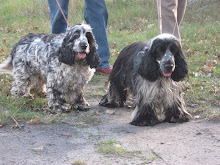
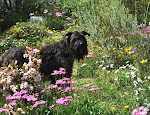
Sun on Sunday for a change! And some spaniels and a bouvier were waiting for us when we arrived at the start of the
Elsie's Peak walk,

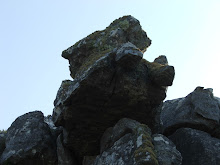
but the spaniels soon left - and there they go with Omie Domes (their human) past the piles of quarried stone that is left over from when Elsie's Peak was a
quarry for building stone and road gravel. We think the walls and ruins at the start of the walk on Mountain Road must have something to do with the quarry works. Sue and Thea soon joined us after taking the wrong road thanks to the Food Lady's incorrect instructions!

An unconcerned Cape
Grassbird. They have recently changed family (which is what I would like to do too sometimes) thanks to molecular research on their genes. They used to be part of the warbler family Sylviidae (larks and swallows) but now have their own family, the African Warblers (
Macrosphenidae) which only share a distant relative with the Sylviidae.

There were lots of these little plants growing in the damp sand of the path, and when you open them up ...

they look like this. Men-in-a-boat (
Colchicum eucomoides).

We walked across to the other side of the mountain with lovely views over Glencairn and Simons Town.

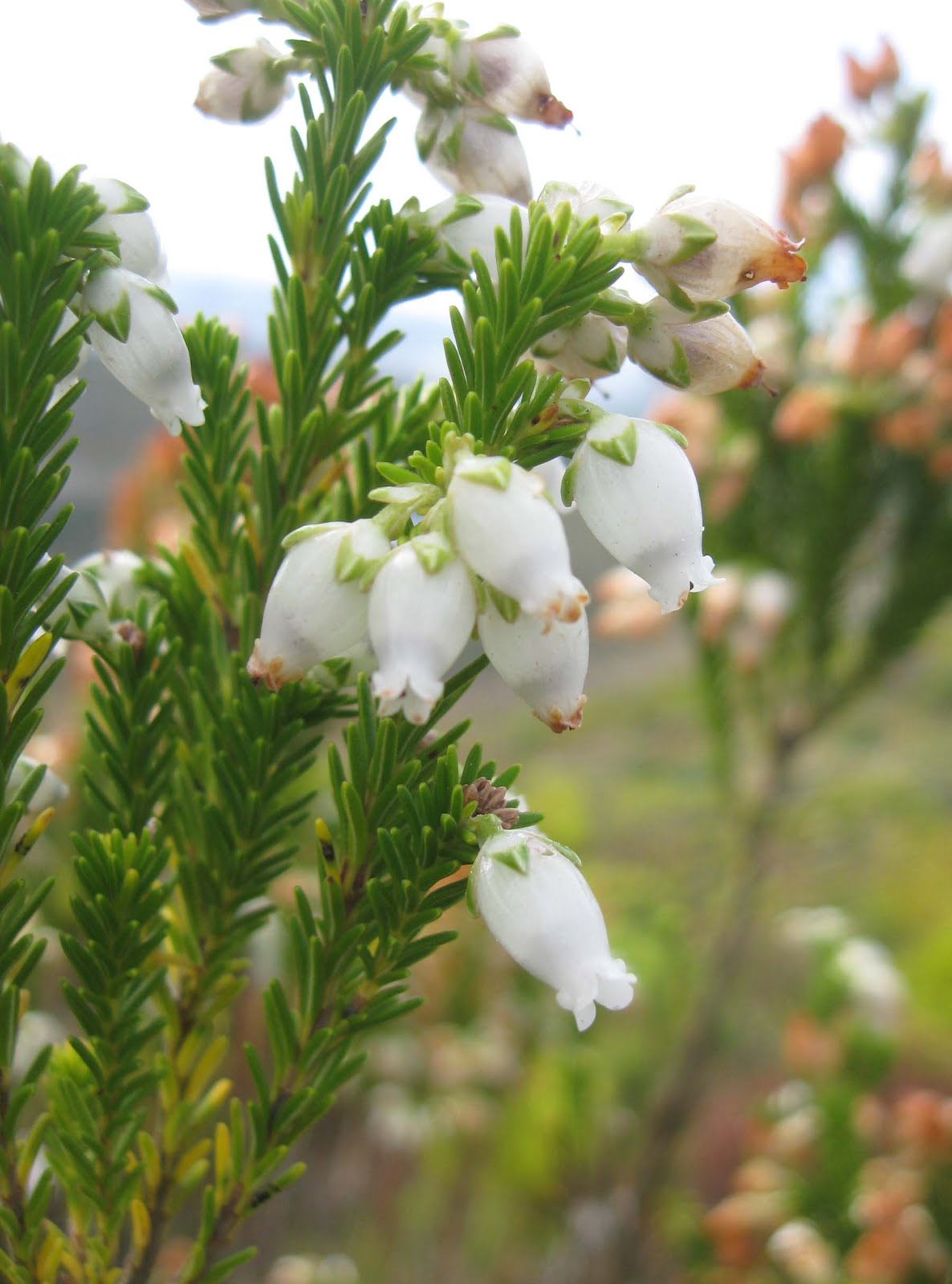
Then Alice and the Food Lady saw an interesting plant - the rare (on the
Red List) False Heath (
Audouinia capitata), which is only known from about 15 localities on the Peninsula and near Hermanus. It is member of the Brunia family (
Bruniaceae) but masquerades as an erica. It is a resprouter – which means it needs fire in order to maintain a healthy population. According to Tony Rebelo, most resprouters thrive in the two to five years after a fire and then die down - so that in 10-year old veld they are often leggy and half dead. On the other hand many of these fynbos resprouters are astonishingly old - as much as 300-800 years old! Every fire prunes and revitalizes them, so although they are very old they don’t look their age (in young veld that is). For more interesting facts on fynbos resprouters and
Andouinia click
here.

And look how patiently Maddy is sitting while all this is being explained! I, on the other hand had left long ago with the Alph, and we had discovered some ...

BABOONS!

But before we could get at them, the Alph clapped us in leads. Spoilsport.

So all we could do was watch - and quiver a bit. Just you keep watching out baboon! Shirley Strum is strumming up
support to have you lot chased FAR away where you belong.

While we fantasized about chasing baboons all the way to Cape Point, the Food Lady and the others carried on botanising. This is a Granny Bonnet/Moederkappie (
Disperis capensis var.
capensis) that is also sometimes called a Cape Witch Orchid.

A pretty blue Pyjamabush or Agtdaegeneesbos (
Lobostemon fruticosus). A member of the Forget-me-not family, Boraginaceae.

Teatime! With shaved kudu carpaccio (we dogs only got a faint whiff of this most delicious offering from Thea), Sue hiking biscuits (ditto), same old same old rusks (a tiny crumb), and same old same old beanos (two each). Maddy, Alice, Sue, the Alph with me still on the lead because of baboon smells, and Thea. FL taking the photo, and Dougal deep in a rodent hunt somewhere.

Beautiful pink and silver
Amphithalea ericifolia - a member of the fabulous Fabaceae. Someone on
iSpot called it a Winter Pea which we think is a nice name seeing it flowers in winter.

We saw this sign so knew we were on the right track to the trig beacon at the other end of Brakkloofrant.

Cup Fungus (
Peziza) in the sandy path. These grow on rotting wood or dung.

Alice admiring a snake thistle bush
Cullumia setosa growing on the sand dunes.

Help needed over this rocky bit please.

Turning round to look back over Elsie's Peak and False Bay. Nearly at the end of Brakkloofrant now. It seems to be mainly sand dune, and we wish we had a geologist with us.

A dainty little Weeskindertjie probably
Nemesia versicolor in the sand.

The Alph and me on the top! The chap on the left got cross because he thought the Alph was taking a swipe at his dog with THAT stick, but in actual fact, he was taking a swipe at Dougal who was trying to sink his teeth into the other dog.

The Alph with Thea at the trig beacon.

View over Sun Valley.

All this and heaven too!

Dougal surveying the suburb where he was born. Noordhoek in the far distance.

This kid decided to try and fix the broken trig beacon.

One last flower photo on the way back -
Manulea cheiranthus.

Then almost at the end of the walk we saw a tortoise! It was legging it across the path and disappeared into the undergrowth. Phew - quite an exciting walk.
Click here for a description of the route.
 Another rather bleak and grey day but we decided to climb up Devil's Peak because our human brother is here on business in Cape Town and he wanted some exercise. We picked him up at his posh - if rather grey - hotel on the foreshore of Cape Town.
 The Foodlady was intrigued by all the new hotels and apartments here. Hello human brother!
 Paul and Pauline joined us on Tafelberg Road, and soon we were zigzagging up the side of Devils Peak into some colourful fynbos. This is Phil's photo of Dougal on the path.
  A close-up of the Red Heath (Erica abietina subsp. abietina) one of the many plants endemic to Table Mountain. (The name abietina is Latin for "like a fir tree" and refers to the leaves which resemble those of fir trees of the genus Abies.)
 Another colourful erica that only occurs on Table Mountain - the Berry Heath (Erica baccans).
 A blushingly beautiful shrub to shake away the grey: Leucadendron salignum. We were missing Alice who knows all the names.
 Creamy white Clutia alaternoides flowers.
 Although we were feeling a bit more colourful, it was very wet and the paths had turned into streams.
 Phil and Paul discussing how best to brew beer.
 We turned left here,
  and headed straight up, Phil catching up on his correspondence all the while.
 A photo opportunity. A tad grey but the weather was holding out for the final assault on the Peak.
 The Devils Peak Heath (also Erica abietina but subspecies diabolis becuase it only grows on Devils Peak and nowhere else in the world. It is similar to subsp. constantiana but differs in having hairy sepals and a slightly hairy corolla). Botany lesson over,
  we eventually got to the top. I was not so sure about climbing up there!
 Team Devil's Peak: Pauline, Paul, Phil, Me (can you see my nose?), Dougal looking stricken and the Alph.
 Then the mist started rolling in from the sea. Table Bay ahead.
 Tea in the mist overlooking Newlands Ravine and False Bay.
 Waiting for our biscuits and any other crumbs.
 Then we set off down again. Phil still doing a bit of admin.
 It was quite scary in the mist and Pauline and the Food Lady were scared we would get lost in the grey swirling mist so we followed close behind Paul.
 Luckily it wasn't too dense and we could see quite a lot - including this erica that was flowering in great swathes all over the Saddle. The Food Lady thinks it is the Smooth Heath (Erica glabella).
 We aslo saw this fascinating forest of moss and lichen growing on a dead Psoralea shrub. The mustard yellow lichen could be a species of Teloschistes. The discs are fruiting bodies or reproductive structures called apothecia.
 And pink and pretty Leucadendron cones. Alice says it is probably Leucadendron xanthoconus which grows on sandsotne upper slpes and plateaux.
 Some pesky pixies in Cape Anemones (Anemone tenuifolia) needed chasing.
 " Come on bad dogs! You will fall over the edge." As if!
 Shall I have one last leap into the fynbos before we follow them down? Hmmmm. We do not enjoy the path down.
 But soon we were down again, and we dropped Phil back at his urban chic hotel to pick up his car. You can see Lions Head in the distance.
 Fun river boats tootle along the canals on the foreshore now.
 On the way home we looked up at Devils Peak which was looking quite dramatic and cloud covered.
 In fact you can't even see the top where we were an hour ago! Not bad for two vertically challenged dogs.
 The next day, the Food Lady, Phil and Si went to Origins coffee shop where Phil wanted to try out this special craft beer by the Devils Peak Brewery.
 And this is the other human brother with a flat white and a volume of Thus spake Zarathustra by Nietzche that he picked up from Clarkes Bookshop on Long Street for R10.
 This morning it was only us four on the walk, and as it was a bit wet, we decided to do a short walk in Silvermine. We parked at the dam and set out on the Amphitheatre walk through purple and pink ericas that made us Scots feel like we were frolicking in the Highlands This is the Wind Heath (Erica hispidula).




 no time to eat the daisies, or